

 F. Bermejo-Pareja
Neurosciences and History 2026;14(1): 43-64
Type of article: REVIEW

AUTHOR
F. Bermejo-Pareja
Neurologist. Research consultant, Imas12, Hospital Universitario 12 de Octubre, Madrid, Spain.
Professor emeritus, CIBERNED, Instituto de Investigación Carlos III, Madrid, Spain.
Honorary Professor, Universidad Complutense de Madrid, Madrid, Spain.
ABSTRACT
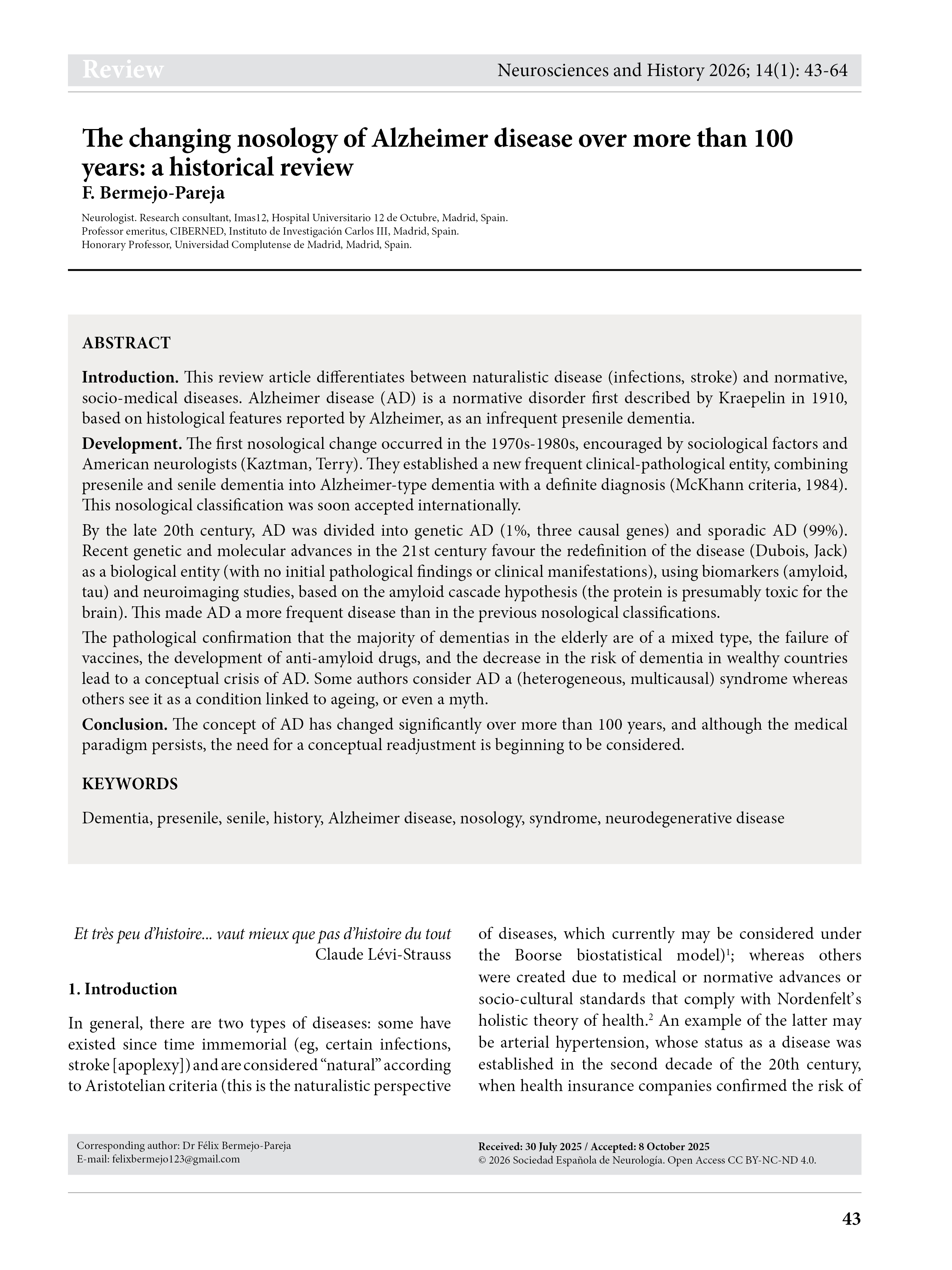
Objective. This review article differentiates between naturalistic disease (infections, stroke) and normative, socio-medical diseases. Alzheimer disease (AD) is a normative disorder first described by Kraepelin in 1910, based on histological features reported by Alzheimer, as an infrequent presenile dementia.
Development. The first nosological change occurred in the 1970s-1980s, encouraged by sociological factors and American neurologists (Kaztman, Terry). They established a new frequent clinical-pathological entity, combining presenile and senile dementia into Alzheimer-type dementia with a definite diagnosis (McKhann criteria, 1984). This nosological classification was soon accepted internationally.
By the late 20th century, AD was divided into genetic AD (1%, three causal genes) and sporadic AD (99%). Recent genetic and molecular advances in the 21st century favour the redefinition of the disease (Dubois, Jack) as a biological entity (with no initial pathological findings or clinical manifestations), using biomarkers (amyloid, tau) and neuroimaging studies, based on the amyloid cascade hypothesis (the protein is presumably toxic for the brain). This made AD a more frequent disease than in the previous nosological classifications.
The pathological confirmation that the majority of dementias in the elderly are of a mixed type, the failure of vaccines, the development of anti-amyloid drugs, and the decrease in the risk of dementia in wealthy countries lead to a conceptual crisis of AD. Some authors consider AD a (heterogeneous, multicausal) syndrome whereas others see it as a condition linked to ageing, or even a myth.
Conclusions. The concept of AD has changed significantly over more than 100 years, and although the medical paradigm persists, the need for a conceptual readjustment is beginning to be considered.
KEYWORDS
Dementia, presenile, senile, history, Alzheimer disease, nosology, syndrome, neurodegenerative disease
Neurosciences and History 2026;14(1): 43-64